
The modern web depends heavily on structured data transfer, and URLs are one of the most important elements in that process. Every time you click a link, send a request, or open a web page, encoded information is being processed behind the scenes. This is where decoding plays a critical role in making data readable and functional for both users and systems.
URL encoding and decoding ensure that special characters, spaces, and non-standard symbols are safely transmitted across the internet. Without this process, many web requests would break or display incorrectly. Beginners often face confusion when they encounter errors related to URL handling, which leads them to search for terms like url decoder spellmistake when something goes wrong in decoding results.
Understanding these issues is essential for developers, SEO professionals, and even digital marketers who rely on clean URL structures. This guide will break down everything from basic concepts to advanced troubleshooting so you can handle URL decoding errors with confidence.
What is URL Encoding and URL Decoding
url decoder spellmistake encoding is a mechanism used to convert characters into a format that can be safely transmitted over the internet. Since URLs can only contain specific ASCII characters, any special symbols such as spaces, commas, or non-English characters must be converted into a percent-based format. This ensures compatibility across browsers, servers, and APIs.
URL decoding is the reverse process of encoding. It takes encoded strings and converts them back into a readable format for humans and systems. For example, a space encoded as %20 will be decoded back into an actual space character. This transformation is essential when displaying data or processing user inputs correctly.
Without encoding and decoding, web communication would be chaotic and error-prone. Many systems would fail to interpret URLs correctly, leading to broken links or incorrect data retrieval. This is why decoding is a fundamental concept in web development and data processing.
Developers often encounter situations where encoded url decoder spellmistake appear confusing or broken, especially when parameters are passed through APIs or tracking systems. Proper decoding ensures that the original structure of the data is restored accurately, preventing misinterpretation and system errors.
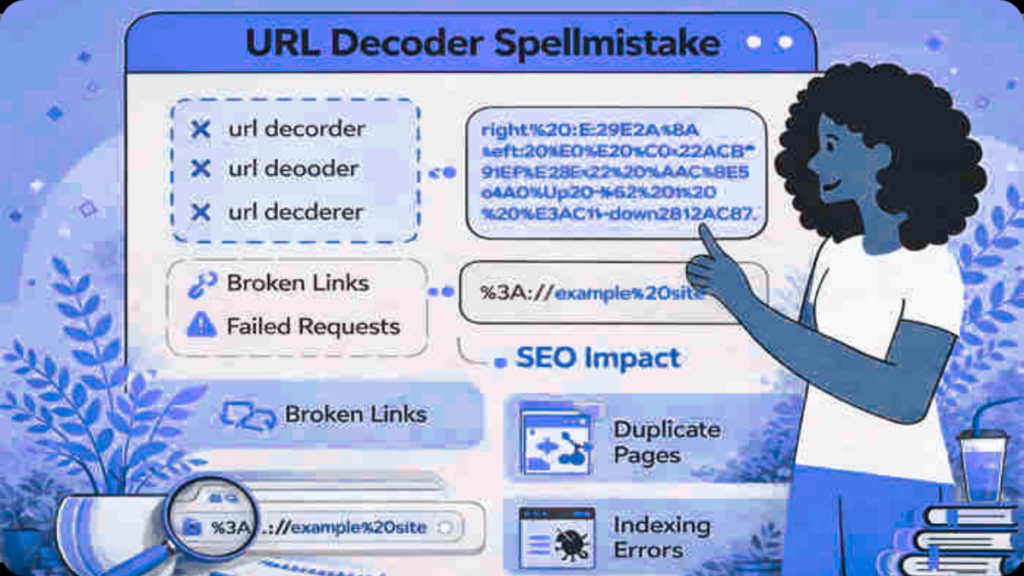
Understanding URL Decoder Spellmistake
The term url decoder spellmistake is commonly searched by beginners who encounter unexpected errors while decoding URLs. In reality, it is not an official technical term but rather a combination of misunderstanding and typing confusion. It often reflects issues where decoded output appears incorrect due to malformed input.
When users input improperly encoded URLs, the decoding process may produce unreadable or broken results. This leads to the assumption that there is a “spellmistake” in the decoder itself. However, the problem usually lies in the original encoded string rather than the decoding tool.
In many cases, special characters are either missing or incorrectly formatted before decoding. This creates confusion for users who expect clean output but receive corrupted or incomplete results. That is why url decoder spellmistake has become a common keyword among people trying to troubleshoot such issues.
Understanding this concept helps users realize that decoding tools are not faulty. Instead, errors originate from incorrect encoding practices, copy-paste issues, or mismatched character handling between systems.
Common Causes of URL Decoding Errors
URL decoding errors can occur for several reasons, most of which are related to improper encoding at the source level. One of the most common causes is missing or incomplete percent encoding, where special characters are not properly converted before transmission. This leads to incorrect interpretation during decoding.
Another frequent issue is copy-paste corruption, where URLs are transferred between systems without preserving encoding integrity. This can introduce hidden characters or formatting changes that break the decoding process. As a result, users may mistakenly associate the problem with url decoder spellmistake behavior.
System mismatches also play a role in decoding errors. Different platforms may interpret encoding rules slightly differently, especially when handling UTF-8 or legacy formats. This inconsistency often leads to unexpected output during decoding operations.
Finally, manual editing of encoded URLs is a major source of errors. When users attempt to modify encoded strings without proper tools, they often introduce invalid sequences. This results in broken decoding and unreadable outputs that confuse both users and systems.
How to Fix URL Decoder Spellmistake Issues
Fixing decoding issues requires a structured approach that starts with verifying the original encoded URL. Before decoding, it is important to ensure that the string follows proper encoding standards. Any missing or incorrect percent-encoded values should be corrected first.
Many users facing url decoder spellmistake issues can resolve them by using reliable online decoding tools. These tools automatically handle encoding rules and reduce the chances of manual errors. They also help identify malformed inputs and suggest corrected outputs.
Developers can also use programming functions in languages like JavaScript, Python, or PHP to ensure accurate decoding. These built-in functions are designed to handle complex encoding scenarios and reduce human error. Using such methods ensures consistent and reliable results.
In more advanced cases, debugging tools can be used to trace how URLs are processed across systems. This helps identify where the encoding breaks down and allows developers to fix the root cause rather than just the symptoms.
Tools for URL Encoding and Decoding
There are many tools available online that simplify the process of encoding and decoding URLs. These tools allow users to quickly paste encoded strings and convert them into readable formats without technical complexity. url decoder spellmistake They are especially useful for beginners and non-developers.
Browser-based developer tools also provide built-in decoding features. These tools help inspect network requests and view decoded parameters directly. This is particularly useful for debugging web applications and API responses.
Programming languages also offer powerful decoding functions.url decoder spellmistake JavaScript provides built-in methods, while Python and PHP offer libraries that handle encoding and decoding efficiently. These tools are widely used in production environments for accuracy and speed.
Using the right tool depends on the complexity of the task. Simple decoding can be handled online, while large-scale or automated systems require programmatic solutions for better control and reliability.
Best Practices to Avoid URL Decoding Problems
Preventing decoding issues starts with proper encoding practices. Developers should always ensure that URLs are encoded correctly before being transmitted or stored. This reduces the chances of errors during decoding and improves system reliability.
Avoiding manualurl decoder spellmistake manipulation is another important practice. Editing encoded strings by hand often introduces errors that are difficult to detect later. Instead, automated functions should be used to maintain consistency.
Standardizing encoding rules across systems is also essential. When different platforms follow different encoding methods, mismatches are likely to occur. Consistency ensures smooth data flow and prevents unexpected decoding errors.
Testing URLs before deployment is another key step. By validating encoded and decoded outputs in advance, developers can identify issues early and avoid production problems.
Real-World Use Cases of URL Decoding
URL decoding is widely used in web development, especially when handling API requests and query parameters. It allows systems to interpret user input correctly and display accurate results. Without decoding, many applications would fail to process data properly.
In SEO and digital marketing, decoding helps analyze tracking URLs and campaign parameters. Marketers rely on decoded data to understand traffic sources and user behavior. This ensures accurate reporting and better decision-making.
Email marketing systems also depend on URL decoding. Links embedded in emails often contain encoded parameters for tracking purposes. Proper decoding ensures that these links function correctly when users click them.
Developers frequently use decoding during debugging sessions. When investigating broken links or API errors, decoding helps reveal the actual structure of transmitted data.
Advanced Insights into URL Decoding
At a deeper level, url decoder spellmistake is closely tied to character encoding systems like UTF-8. These systems ensure that global characters from different languages are properly represented in web communication. Without this standardization, decoding would be inconsistent and unreliable.
Browsers interpret encoded URLs based on strict rules defined by web standards. These rules ensure that all systems understand encoded data uniformly, regardless of platform or device. This consistency is essential for global web functionality.
Security also plays a role in URL decoding. Improper handling of encoded data can lead to vulnerabilities such as injection attacks. Proper validation and sanitization of decoded data are crucial for maintaining secure applications.
Understanding these advanced concepts helps developers build more robust systems and avoid common pitfalls associated with decoding processes.
Conclusion
URL decoding is a fundamental process that ensures smooth communication between web systems and users. While errors can occur due to improper encoding, understanding the root causes helps eliminate confusion. Many issues labeled as url decoder spellmistake are actually results of incorrect input rather than tool failure.
By following proper encoding practices, using reliable tools, and understanding how decoding works, users can avoid common problems and ensure accurate data processing. Mastering this concept is essential for anyone working in web development, SEO, or digital systems.
FAQs
What does URL decoder spellmistake mean
It refers to a common misunderstanding where decoding errors are mistakenly attributed to spelling or tool issues, while the real cause is usually incorrect URL encoding.
Why does url decoder spellmistake fail sometimes
Decoding fails when URLs are not properly encoded, contain missing characters, or include corrupted formatting from copy-paste or system mismatches.
How do I fix a broken encoded URL
You can fix it by verifying correct encoding, using reliable decoding tools, or applying programming-based decoding functions.
What is the difference between URL encoding and decoding
Encoding converts characters into a safe format for transmission, while decoding converts them back into readable form.
Which tools are best for URL decoding
Online decoder tools, browser developer tools, and built-in programming language functions are all effective depending on the use case.
Can URL decoding affect SEO performance
Yes, improper URL handling can lead to broken links or incorrect tracking, which may negatively impact SEO performance.
Is URL decoding the same in all programming languages
The concept is the same, but implementation varies slightly across programming languages based on their built-in functions and libraries.